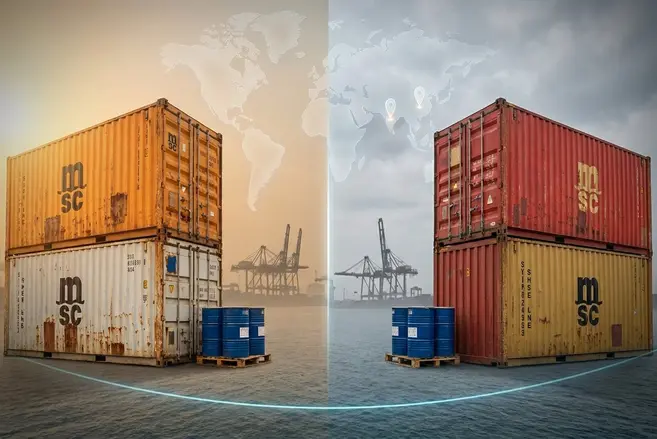
Same chemical. China quotes $400/MT with 10-week lead time. India quotes $420/MT with 6-week lead time. Your procurement team asks: Which do we choose? The answer depends on your priorities, volumes, and risk tolerance. This bulk chemical procurement guide provides the data to decide.
Neither origin is universally “better.” China offers lower unit costs; India offers reliability and compliance advantage. Most smart procurement teams source from both, optimizing the split based on their specific needs.
Quick Comparison Summary
| Factor | China | India | Middle East | Winner for Most |
| Price per MT (base) | Lower: $350–500 | Higher: $380–550 | Competitive: $365–480 | China (by 5–10%) |
| Lead Time | 8–12 weeks CIF | 6–8 weeks CIF | 6–7 weeks CIF | India/ME |
| Quality Consistency | Variable | Consistent | Consistent | India |
| Compliance (REACH, BIS) | Weaker | Stronger | Medium | India |
| Payment Terms | Rigid (TT/LC) | Flexible | Medium | India |
| Geopolitical Risk | High | Low-Medium | Low-Medium | India |
| Volume Flexibility | High | Medium | Medium | China |
| Documentation Speed | Slow (2–3 weeks) | Fast (1–2 weeks) | Medium | India |
Takeaway: China wins on price; India wins on everything else. Best strategy: multi-source (60% India, 40% China).
Pricing Comparison: Who’s Actually Cheaper?
China Base Pricing
Caustic soda: $360–420/MT FOB Qingdao. This is 10–15% lower than India’s $380–450/MT FOB Mundra.
TiO2: $2,050–2,150/MT China vs. $2,150–2,250/MT India. Roughly $100/MT cheaper from China.
Solvents: China sourcing (acetone, toluene, xylene) typically 8–12% lower per MT than India.
Why lower? China has: lower labor costs, massive production scale, cheap energy (coal-based), and consolidated supplier base (SINOPEC, Shandong majors dominating).
India Base Pricing
India’s premium (5–15% higher than China) reflects: higher production costs, stricter regulatory compliance (REACH pre-compliance, BIS certification built-in), higher labor standards, and quality consistency measures.
Hidden Cost Reality: True Landed Cost Comparison
China’s unit cost advantage disappears when you factor hidden costs.
| Cost Component | China | India |
| Base FOB/CFR price | $400/MT | $420/MT |
| SDS validation (non-EU format → EU format) | $500–2,000 per import | Minimal ($100–500) |
| Testing/incoming QA (quality verification) | $500–2,000 per shipment | $100–500 |
| Rework (off-spec batches) | 2–5% rejection rate | <1% |
| REACH/compliance overhead | $1,000–3,000 per import | Minimal/included |
| True cost per MT (50 MT container) | $408–$425/MT delivered | $420–$423/MT delivered |
Result: After hidden costs, China’s price advantage shrinks to 0–3%, sometimes disappears entirely. India wins on simplicity and cost predictability.
Lead Time: India’s Competitive Advantage
China Lead Times
Supplier production: 2–3 weeks.
Shipping (China to EU/India): 4–5 weeks typical.
Customs clearance: 2–4 weeks (highly variable due to environmental inspection shutdowns, policy changes).
Total: 8–12 weeks typical CIF, highly variable.
Volatility: Environmental inspections can add 2–4 weeks unpredictably. Port congestion during peak season (July–September) adds 1–2 weeks.
India Lead Times
Supplier production: 2 weeks typical.
Shipping (India to EU/worldwide): 4–6 weeks typical.
Customs clearance: 1–2 weeks (ports run predictably).
Total: 6–8 weeks typical CIF, highly predictable.
Volatility: Low. Indian ports (JNPT, Mundra, Chennai) operate under stable protocols. Seasonal variation is minimal.
Procurement Implication
India: Better for just-in-time (JIT) inventory management. Predictable supply = smaller safety stock needed = lower working capital.
China: Requires larger safety stock (12–16 weeks vs. 8–10 weeks). Unpredictability = carrying cost.
For monthly orders, India’s 6-8 week lead time means you can order month M for delivery in month M+2. China’s 8-12 week variability means ordering for month M+3 with buffer.
Working capital impact: If you manage $1M/month chemical spend with India (8-week lead time), you carry ~$250K in inventory. With China (12-week lead time + buffer), you carry ~$400K. That’s $150K of working capital tied up — at 5% financing cost, that’s $7,500/year in finance cost difference. China’s price savings of 2–3% may not justify this.
Quality Consistency: India’s Real Advantage
China Quality Profile
Large integrated producers (SINOPEC, China National Chemical Corporation): 95%+ on-spec. World-class.
Mid-size regional suppliers: 70–85% on-spec. Variable.
Small traders: 50–70% on-spec. Frequent defects.
Problem: Many procurement teams don’t know which supplier tier they’re buying from until material arrives. CoA (Certificate of Analysis) fraud is common — documentation shows 98% purity, actual material is 94%. Off-spec discovery happens at your lab after shipment arrives.
India Quality Profile
Established suppliers (Deepak Nitrite, UPL, Westchemical, etc.): 95%+ on-spec consistently.
BIS certification (mandatory for many chemicals in Indian market) ensures baseline quality.
CoA reliability: 90%+ accurate. Fraud is lower due to stronger regulatory enforcement and international customer base scrutiny.
Consistent quality floor: Even smaller Indian suppliers maintain higher quality standards due to regulatory compliance requirements.
Testing Cost Impact
China: Budget $500–2,000 per shipment for incoming lab testing (Karl Fischer, HPLC, GC, titration as needed). Many procurement teams test every batch from China suppliers.
India: Budget $100–500 per shipment for verification testing. Many teams test only first batch from new supplier, then spot-check.
Annual impact (12 shipments/year): China = $6,000–24,000 testing cost. India = $1,200–6,000. Another 5–18% of savings China’s price advantage isn’t delivering.
Compliance & Regulatory Risk: Increasingly Important
REACH Compliance (EU Market)
China suppliers: 70% don’t provide EU-format SDS out of the box. Expect 2–3 weeks validation/translation work for each shipment.
Cost: $500–3,000 per import.
India suppliers: 85% pre-compliant with EU SDS format. Ready to ship with correct documentation.
Cost: $200–500 or included in supplier pricing.
Implication: If you import into EU, India sourcing cuts 2–3 weeks from lead time and €1,000–2,000 from first-import costs.
BIS Certification (India Market)
China chemicals: Cannot be legally sold in India without BIS (Bureau of Indian Standards) certification. Extra compliance layer required.
India chemicals: Pre-certified, no additional steps.
Implication: If your end-market is India, Indian suppliers eliminate one compliance step. China suppliers require additional registration/certification in India.
GHS Labeling & Documentation
China: 50–60% of suppliers provide GHS-compliant labeling on first shipment. Many require relabeling at destination port.
India: 85–90% pre-compliant.
Geopolitical Risk: The Growing Factor Favoring India
China Risk Factors (2026–2027 Context)
US-China trade tensions: Tariffs on chemicals can swing 5–15% unpredictably. Export restrictions on certain chemicals (rare earth derivates, advanced materials) emerging.
Environmental enforcement: Chinese government’s enforcement of environmental standards varies by region and political cycle. Production shutdowns during “green” enforcement crackdowns can halt supply for weeks.
Policy unpredictability: Chemical export policy changes (VAT rebates, export limits) announced with minimal notice. Can disrupt pricing and lead times suddenly.
Supply chain concentration: Many key chemicals have 2–3 major global producers, all in China or China-dependent. A single major plant shutdown (environmental, accident, natural disaster) can disrupt global supply.
Currency volatility: CNY (Chinese Yuan) fluctuates 3–8% annually. Quoted pricing in CNY can shift your landed costs unexpectedly.
India Risk Factors
Geopolitical stability: India’s trade relationships are stable. No major tariff threats or export restrictions anticipated.
Regulatory consistency: Environmental and labor standards are stable and predictable. Enforcement is consistent.
Supplier diversification: Chemical production is spread across multiple regions (Gujarat, Maharashtra, Andhra Pradesh, Telangana). No single region’s shutdown halts all supply.
Currency stability: INR (Indian Rupee) is more stable than CNY for export pricing. Less fluctuation risk.
ESG tailwinds: Many Western companies are actively diversifying away from China concentration. India sourcing is viewed positively by customers and boards.
Procurement Strategy
For supply-critical chemicals: India reduces risk. A supply interruption in China costs you. A supply interruption in India is more easily absorbed through supplier switching or inventory.
For cost-sensitive, non-critical materials: China is acceptable if you have buffer inventory.
Optimal: Balanced sourcing. 60–70% India (reliability), 30–40% China (cost). Both suppliers competing keeps pricing honest; supply diversity reduces risk.
Sourcing Decision Framework: Choose Based on Your Priorities
Choose China If:
✓ Price is the dominant decision factor and you can absorb longer lead times.
✓ You have large, predictable annual volumes (50+ MT/month) that justify dedicated relationship management.
✓ You have robust incoming quality testing capability and don’t mind rework/rejection cycles.
✓ Your end-market is not regulated (no REACH, BIS, or similar requirements).
✓ You have 12–16 week safety stock capacity and working capital to maintain it.
✓ You can tolerate geopolitical disruption and policy unpredictability.
Choose India If:
✓ Lead time and supply reliability are critical (JIT manufacturing, limited inventory capacity).
✓ Quality consistency matters more than unit cost savings (regulated products, premium customers).
✓ You sell into regulated markets (EU, India, regulated Asia).
✓ You need payment term flexibility (credit terms, tiered pricing negotiation).
✓ You want to minimize geopolitical risk and ESG concerns.
✓ Your end-market values “diversified sourcing away from China.”
Choose Multi-Source (60% India, 40% China) If:
✓ You want to minimize single-source risk and supply chain vulnerability.
✓ You have volumes (30+ MT/month) to support two active supplier relationships.
✓ You’re in a price-volatile market and want to hedge by buying volume strategically (lock India quarterly, spot trade with China when prices dip).
✓ You operate globally with different regional regulatory requirements (India for EU, China for cost-focused markets).
Real-World Scenarios: What You’ll Actually Face
Scenario 1: Paint Manufacturer Exporting to EU
Requirement: Caustic soda, 50 MT/month, REACH-compliant.
China option: $400/MT FOB + $1,500 REACH documentation per import (quarterly) + $1,000 testing per import = effective $403.5/MT true cost over the year. 10-week lead time = 10-week safety stock.
India option: $420/MT FOB, pre-REACH compliant = $420/MT true cost. 6-week lead time = 6-week safety stock.
Decision: Roughly equal cost. India wins on lead time (saves 4 weeks safety stock = $12K working capital) and compliance certainty. India supplier is better choice.
Scenario 2: Textile Dyer in India Market
Requirement: Soda ash, 30 MT/month, BIS certified.
China option: $350/MT FOB + $2,000 BIS certification per import + $500 testing per import (annual burden) = $412.5/MT effective cost. 10-week lead time = long supply chain.
India option: $380/MT FOB pre-BIS certified = $380/MT true cost. 6-week lead time.
Decision: India wins decisively on cost ($32.5/MT savings) and regulatory compliance. No question.
Scenario 3: Specialty Chemicals, Variable Demand, Global Market
Requirement: Specialty amines, 5–15 MT/month variable, no strict compliance.
China option: Requires 10 MT minimum order. Pricing: $1,800/MT. Inflexible.
India option: 1 MT minimum order (Raw Source standard). Pricing: $2,100/MT but negotiable by volume. Flexible.
Decision: India wins on flexibility. You can adjust volumes monthly matching demand. China forces you to overstock or miss sales. Flexibility value > 15% price premium in this scenario.
The 2027 Outlook: Why India’s Advantage Is Growing
Why India is Gaining Ground
Capacity expansion: India adding chemical manufacturing capacity under PLI (Production Linked Incentive) scheme. New facilities coming online Q2–Q4 2026. Excess capacity will push India prices down 3–5%.
Geopolitical diversification pressure: After 2020–2022 supply chain lessons, procurement teams actively moving away from China concentration. Preference for India is rising.
Quality/compliance emphasis: Customers increasingly demanding REACH, BIS, sustainability certifications. India suppliers meet these standards naturally; China suppliers must add them.
Tech adoption: Indian chemical companies are investing in digital supply chains, real-time tracking, and modern quality systems. Closing the gap with international standards.
Result: India’s 5–15% cost premium will shrink to 0–5% by 2027. Combined with reliability and compliance advantage, India sourcing becomes the default choice for most procurement teams.
How Raw Source Helps: Structured India + China Strategy
Raw Source sources from vetted suppliers across both India and China. For price-sensitive, high-volume sourcing, we negotiate the best Chinese terms. For supply-critical applications, we secure reliable Indian sources with guaranteed quality and lead time.
For most procurement teams, we recommend balanced sourcing: 60–70% India (baseline, reliable, compliant), 30–40% China (optimize costs, maintain supply flexibility). We manage both relationships; you get simplicity plus risk hedging.
Request a sourcing strategy consultation and we’ll analyze your specific volumes, markets, and priorities to recommend optimal India/China split.
Frequently Asked Questions
[rank_math_rich_snippet id=”s-294da5b5-b6d1-4cf5-92df-3f3ef8b9440e”]
Conclusion
No origin is universally better. China offers lower unit costs; India offers reliability, compliance, and lead time advantage. True cost comparison (including hidden compliance, quality, and working capital costs) often favors India despite higher per-ton pricing.
For smart procurement teams: Balanced sourcing. 60–70% India, 30–40% China. Supply reliability from India; cost control from China. Manage both, optimize for your specific business model.
2027 outlook: India’s cost premium shrinking; India becoming the default choice for most bulk chemical sourcing as geopolitical diversification pressure continues.